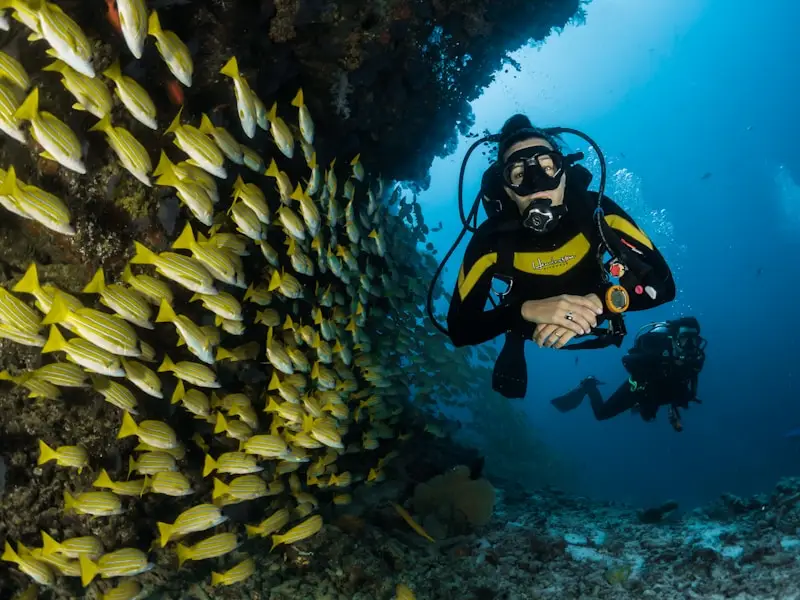
The house reef can make or break a Maldives honeymoon. Here's what to look for and where to find the best underwater experiences.
There is something profoundly intimate about snorkeling together. Unlike scuba diving, with its apparatus and regimentation, snorkeling requires nothing more than a mask and the willingness to put your face beneath the surface. You float together, suspended between worlds, sharing discoveries in real-time—a tap on the arm, a pointed finger, the universal wide-eyed expression of wonder. In the Maldives, where the underwater world rivals the above-water beauty, these shared moments become honeymoon memories of the most vivid kind.
The Maldives archipelago stretches across nearly 900 kilometres of the Indian Ocean, comprising 26 atolls and roughly 1,200 islands. This geography creates an extraordinary diversity of marine environments, from shallow house reefs accessible directly from your villa to remote thilas (underwater pinnacles) teeming with pelagic life. For couples, the question is not whether to snorkel but where—and with what level of adventure.
The House Reef Experience
The majority of luxury Maldivian resorts are built on islands ringed by house reefs—coral formations that begin mere metres from the beach or your overwater villa. These accessible reefs offer the ultimate convenience: simply don your mask and fin from your private deck, slip into the water, and find yourself among reef fish, corals, and often much larger creatures within minutes.
The quality of house reefs varies enormously between resorts. Some properties, like Baros Maldives and Anantara Kihavah, have invested heavily in reef conservation, with the result that their house reefs burst with life. Others, particularly those in heavily developed areas, may offer less rewarding snorkeling. When booking, ask specific questions: What percentage of coral is live? What species are regularly sighted? Is there a marine biologist on staff?
For couples, the house reef offers irreplaceable advantages. You can snorkel at dawn, when the reef awakens and the light transforms the underwater world into cathedral hues of blue and gold. You can return at dusk, when different species emerge and the experience shifts from visual to almost meditative. There's no schedule to keep, no boat to catch—just the sea and each other, on your own terms.
Floating above the reef at sunrise, with nothing but the sound of your own breath and the occasional flash of a parrotfish, you remember what it means to be truly present.
Beyond the House Reef: Guided Excursions
Every reputable resort offers guided snorkeling excursions to sites beyond the house reef, and these trips can elevate your Maldives experience from excellent to extraordinary. The destinations range from nearby thilas accessible by speedboat to full-day adventures reaching pristine sites hours from your resort.
Manta ray snorkeling ranks among the Maldives' most magical experiences. Between May and November, the southwest monsoon brings plankton-rich waters that attract these gentle giants to cleaning stations throughout the archipelago. Hanifaru Bay in Baa Atoll witnesses the largest gatherings, with dozens of mantas sometimes feeding together in a ballet of wings and open mouths. Swimming alongside these creatures—their wingspan reaching four metres, their movements impossibly graceful—is humbling in the truest sense.
Whale shark encounters require more luck but reward with even greater wonder. The South Ari Atoll, particularly around Dhigurah, offers year-round sightings of these spotted leviathans. Despite their size—adults can exceed ten metres—whale sharks are filter feeders, posing no danger to snorkelers. Floating beside one as it cruises the blue, mouth agape, is to feel suddenly, beautifully small.
Night snorkeling reveals a reef transformed. Species that hide during daylight emerge to hunt; bioluminescence sparks with every movement; the familiar becomes strange and wonderful. Most resorts offer night snorkeling either on the house reef or at nearby sites, with guides leading small groups through the darkness.
Practical Matters for Couples
Snorkeling in the Maldives requires minimal equipment but rewards preparation. Bring your own masks if possible; a well-fitting mask that doesn't leak transforms the experience. Full-face snorkel masks have become popular but have limitations in currents and during extended swims—traditional masks remain the choice of serious snorkelers.
Sun protection becomes critical. The Maldivian sun reflects off the water with intensity that catches newcomers off-guard. Reef-safe sunscreen, applied frequently, is non-negotiable—and mandatory at most resorts, given the damage conventional sunscreens inflict on coral. Rash guards provide more reliable protection than sunscreen alone and eliminate reapplication concerns.
If one partner is less experienced than the other, take advantage of resort instruction. A half-hour session on breathing technique and basic safety can transform an anxious snorkeler into a confident one. Better still, book a private guide for your first few excursions; the guide can focus on building confidence while pointing out creatures you might otherwise miss.
The underwater world cares nothing for expertise—only for presence. A novice snorkeler with wonder in their eyes sees as much as any expert.
Where to Go: Our Top Recommendations
For couples prioritizing house reef quality, consider Baros Maldives in North Malé Atoll, where the lagoon drops to a thriving reef within swimming distance of every villa. The resort employs a full-time marine biologist and runs an active coral propagation programme. Alternatively, Anantara Kihavah in Baa Atoll offers UNESCO Biosphere Reserve location plus proximity to Hanifaru Bay's manta gatherings.
For whale shark encounters, the South Ari resorts lead: LUX* South Ari Atoll and Conrad Maldives Rangali Island both position guests well for excursions to the whale shark highway. These resorts also offer exceptional house reefs and the full complement of luxury honeymoon amenities.
For the most immersive marine experience, consider a liveaboard. These boats carry couples (along with other guests) to remote atolls inaccessible from resorts, with multiple snorkeling sessions daily. The Four Seasons Explorer offers luxury liveaboard experiences, while more adventurous options cater to those prioritizing underwater time over five-star appointments.
Conservation and Connection
The Maldivian reefs face existential threats from climate change, with coral bleaching events becoming increasingly frequent. Many resorts have responded with conservation programmes that guests can join—coral gardening, reef monitoring, turtle identification. Participating together adds purpose to pleasure, and the knowledge that you've contributed, however modestly, to the reef's survival enriches the experience.
Perhaps the greatest gift of snorkeling together in the Maldives is the perspective it offers. Floating above the reef, watching fish pursue their ancient routines, feeling the current move around you—these experiences quiet the mind and open the heart. They remind you that you're part of something vast and ancient, that your new marriage begins not in isolation but in connection to a living world of astonishing beauty.
Take that connection home with you. Let the reef teach you something about patience, about attention, about finding wonder in the everyday. And return, if you can, to check on your fish, your coral, your particular patch of blue. The reef will remember you, in its way. You will certainly remember it.